Ryan O'Rourke
  • Home
  • About this blog

Blue Drag

4/17/2014

0 Comments

 
Picture
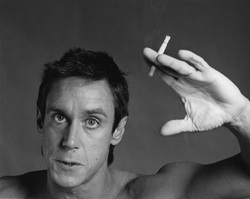
she pouts her cigarettes:
tray to lip, lip to tray
a repetitious play--

then an index flick
an inhale
a splay

in your hands
i’m the smolder
the hack
an organ cloyed, then stubbed black

0 Comments

How to legally release a cover song

6/28/2013

0 Comments

 
Picture
Last night, Mr. Scott Masson and I finished mixing a cover of Iggy Pop’s song, “Mass Production.” The original version clocks in at 8:25, but I trimmed off a little over four minutes that I doubt anyone would miss.

Included in my interpretation of the song are screaming children, industrial machines and samples taken from a German wool processing factory. I also sampled a squeaking hinge from a wrought-iron fence, tuned it, threw it into the sampler and used it to mimic one of the original synth parts. I didn't think it was possible, but this version is way more coked out than anything on The Idiot and I’m so entertained by it that I’m leaning towards including it on an EP release.


Picture
I’ve asked a lot of musician’s about the legalities of releasing a cover song and although everyone had theories about it, no one really knew for sure. In my research, I came across a site called limelight. Essentially, it’s a web-based service that secures mechanical licenses (an agreement that allows users to record and distribute a composition they don’t control) and pays mechanical royalties to the original artists and publishers on your behalf.

The initial process of clearing “Mass Production” took under five minutes. After creating an account, all I had to do was enter the song title, original performer, songwriter, publisher and then information about my own release: album name, artist name, label, length of song and when it would be released.

Lastly, I had to select how I planned on releasing the cover song and give an estimation of the number of units I would release.

In total, it will cost $80 for me to include “Mass Production” on 200 units of my EP. The initial fee to register a track is $15 and the royalty fee—calculated by # of Units x Royalty Rate—was another $65. Not bad.

Once everything is submitted, it takes 10-15 days for the song to clear.

I still need to look into registering the track with ASCAP and find out how this would impact licensing and royalties.


0 Comments

Dear Mother: I'm a hack of a musician

6/17/2013

0 Comments

 
Picture
I've been horribly inconsistent with writing and recording the last couple of weeks. It's easier to sit out on the back porch after dinner, light up a cigarette (or 5) and read Stephen King novels.

I don't really believe in writer's block. I do believe in laziness, boredom and the creative doubt that make me feel like I'd do better to hang it all up for good and instead spend my evenings swinging my feet on that back porch with Annie Wilkes/Kathy Bates.

This morning, though, I came across an article in The New Yorker  written by Pulitzer prize-winning writer John McPhee. I found his short paragraph on writer's block amusing---and more relevant to how I'm feeling than I'd like it to be:

“You are writing, say, about a grizzly bear. No words are forthcoming…You are blocked, frustrated, in despair…What do you do? You write, ‘Dear Mother.’ And then you tell your mother about the block, the frustration, the ineptitude, the despair. You insist that you are not cut out to do this kind of work. You whine. You whimper. You outline your problem and you mention that the bear has a fifty-five-inch waist and a neck more than 30 inches around but could run nose-to-nose with Secretariat. You say the bear prefers to lie down and rest. The bear rests fourteen hours a day. And you go on like that as long as you can. And then you go back and delete the ‘Dear Mother’ and all the whimpering and whining, and just keep the bear.”

Whether or not McPhee's advice is meant to be taken literally, who knows, but it sounds like good therapy.

0 Comments

5 of the best "free" sound archives on the Internet

6/14/2013

0 Comments

 
My love of sampling began in the late 90s with the help of a pirated version of Cool Edit Pro, a Radioshack microphone, a television, and a stack of VHS movies. Over the years, I filled hard drives with random field recordings and drones I’d lifted from movies. I particularly remember spending a lot of time with Texas Chainsaw Massacre, the Alien Trilogy, and Predator. Looking back, I shudder to think of all the hours I spent doing this, especially now that there are so many sound archives floating around. To save you some legwork, I’m going to highlight five of my favorite sound databases.

Note: While everything on the first three databases listed below are either royalty free or released under Creative Commons licenses, I’ll leave it to your discretion to decide whether or not to use or appropriate anything from the Library of Congress or FindSounds.

Picture
Freesound is always my first stop. Browse audio snippets, samples, recordings, bleeps, screams and instrument samples all released under Creative Commons licenses. You never know what you’ll find, but when you are looking for something specific, you can use a customizable keyword search and narrow by type, samplerate, bitdepth and packs. On the rare occasion that you can’t find what you’re looking for, hit the freesound forum and throw down a request.


Picture
While you won’t find straight samples or sounds on Incompetech, you will find royalty-free music. I’ve found lots of useful tracks in the “silent film,” “soundtrack,” and “unclassifiable” categories. I also appreciate that every songs is tagged with the bpms. While everything on the site is free for you to share, remix and repurpose, you will have to attribute the original work to the author.


Picture
Royalty-Free Samples & Sound Recordings is a Sound Cloud group for people who are willing to share their own royalty free samples and field recordings to be used in others' music.


Picture
On the Library of Congress site, you’ll find The National Jukebox, a collection of historical sound recordings available to the public to stream free of charge. A word of caution: according to the disclaimer on the site, “all of these recordings are protected by state copyright laws in the United States.” Do with the disclaimer what you will.  


Picture
Find Sounds is a search engine, but unlike Google, it only searches for audio files hosted by Web sites throughout the world. Are they truly free? According to the folks behind the site, “they do not offer advice on the fair use of these files.” And nor do I.


0 Comments

Writing Lyrics using the Cut-Up Technique? Indeed.

6/6/2013

0 Comments

 
Picture
I’ve always been intrigued by the possibilities of using the “cut-up technique,” an experimental method of composition in which the author:
  1. Selects a piece of print media
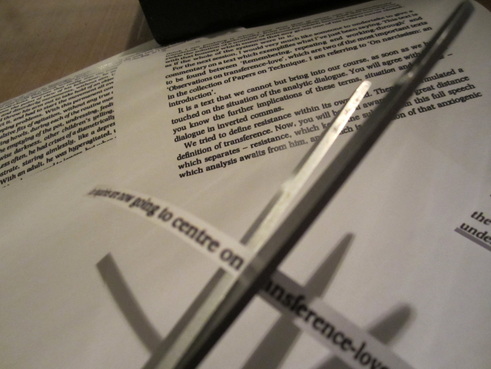
  2. Cuts out each word in the article
  3. Throws the words in a bag
  4. Shakes well
  5. Pulls out one word at a time and copies each down in the order in which they left the bag

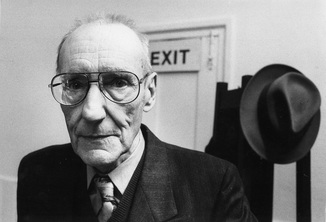
Although the method originated with Dadaists, I came across it when I was researching my thesis and reading William S. Burroughs and Jack Kerouac. 

Burroughs claims to have written the Nova Trilogy—which includes The Soft Machine and The Ticket That Exploded—entirely by using a similar technique called  "montage technique."

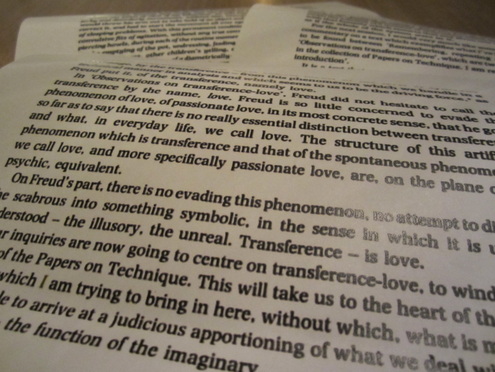
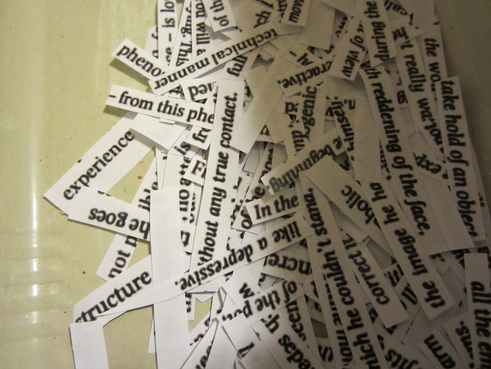
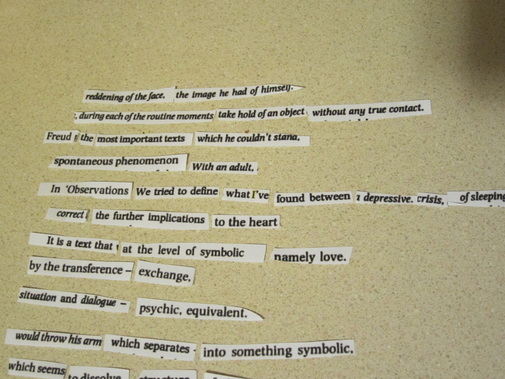
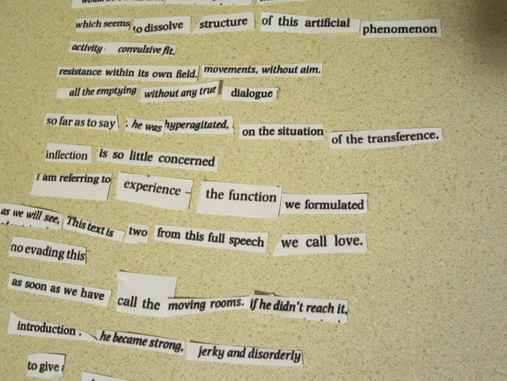
I thought about using Burroughs's  technique to write lyrics on the last FUR record, but never did. I’m finally going to give it a shot. To start, I've selected excerpts from "The Wolf! The Wolf!" a randomly-chosen essay by Jacques Lacan. Here's what happened: 


Picture
Picture
Picture
Once everything was cut out, I threw it into a container, mixed them up and started randomly selecting clips without looking at them. 
Picture
Picture
Here's the final product (I've added punctuation): 

Reddening of the face, the image he had of himself
During each of the routine moments, take hold of an object without any true contact

Freud: the most important text which he couldn't stand
Spontaneous phenomenon with an adult
In observations, we tried to define 
What I've found between a depressive crisis of sleeping problems

Correct the further implications to the heart
It is a text at the level of symbolic--namely love
By transference, exchange, and dialogue, psychic equivalent 

Would throw his arm, which separates into something symbolic, 
Which seems to dissolve structure of this artificial phenomenon

Activity, convulsive fit, resistance within its own field--movements without aim

All of the emptying without any true dialogue
So far as to say, he was hyper-agitated on the situation of transference
Inflection is so little concerned

I am referring to experience, the function formulated. 

As we will see, the text is two
From this full speech we call love
No evading this

As soon as we call the moving rooms
If he didn't reach it

Introduction: He became jerky and disorderly
To give touched observation of his behavior

To arrive at these terms: On the plane of the transference we call love

Not sure how well this works. Thoughts, anyone? 
0 Comments

Oblique Strategies

5/31/2013

0 Comments

 
Picture
It wasn't until recently that I learned about Oblique Strategies, but artists in the know have been using Brian Eno's and painter Peter Schmids's invention since 1975.

Oblique Strategies is a pack of cards containing, as the title suggests, a series of "oblique" dilemmas. Each card contains a unique creative strategy that most artists would never come up with on their own.

So when you find yourself stuck, bored, or continually reaching for comfortable spots on the fretboard, canvas, or whatever medium you use, you can draw a card and put an oblique strategy to use.

The strategies are slightly more sophisticated takes on the messages you might find inside a fortune cookie or in one of those ubiquitous magic 8 balls we had as kids: 
  • "Is it really a mistake?"
  •  "Faced with one choice, do both"
  • "Make what's perfect more human"
  • "Honor thy error as a hidden intention"
  • "Work at a different speed"

In a 1980 radio interview, Eno explained, "If you're in a panic, you tend to take the head-on approach [to creativity] because it seems to be the one that's going to yield the best results. Of course, that often isn't the case--it's just the most obvious and apparently reliable method." 

Oblique Strategies, then, are intended to act as a quiet voice that encourages you to take risks and look awry when your instinct tells you to do the opposite. Although you can still purchase hard copies of the set, they're not cheap. The good news is that you can access a free, online-version of Oblique Strategies here. You can also find a mobile-device version of the 3rd edition (from 1979) by clicking here. 


0 Comments

    Archives

    June 2013
    May 2013

    Categories

    All
    Brian Eno
    Cover Songs
    Cut-Up Technique
    Dadaism
    Free Apps
    Free Samples
    Free Sounds
    Iggy Pop
    Oblique Strategies
    Publishing And Copyrights
    The Idiot
    William S. Burroughs

    RSS Feed

      Contact Me

    Submit

Powered by Create your own unique website with customizable templates.